Links
Historic Narrowboat Owners Club
This site was last updated on 01/01/03
Hagley - Restoration
Hagley was brought from the Basingstoke Canal to Jem Bates' yard at Puttenham on the Aylesbury Arm by water. She was towed by Jem's motor Severn and survived her stern post cracking from top to bottom, a trip on the Thames and making it past the BW lockkeeper at the bottom of the Grand Union.
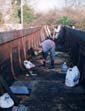
With a bit of patching of the bottom she was stable enough to be left floating until space became available. She was then pulled out and the ice-plating stripped from the bow to make a full assessment of what needed doing.
Meanwhile, we started to look for timber. Two standing dead oak trees were located, one in Kent and the other on a pumping station in Grantchester. These were duly purchased and by a complicated set of organization, milled into 3" thick bottom boards using two portable sawmills, one at each site on the same day. The timber was taken to the boatyard in two loads on a 7.5t dropside lorry and then the boards were manhandled into a stack.
Assessment of her condition showed that a number of bottom boards were needed, together with a new kelson. These were fitted before moving the boat further inland for replanking.
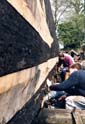
We then started on the new side planks. In total the stem and stern posts, most of the curved planks and all the waterline planks down each side were replaced. This work spanned about two years, working every other weekend.
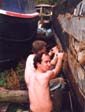
The boat was then caulked across the seams by feeding in oakum (hemp fibre soaked in Stockholm Tar) and hammering it home. In total three 50lb bales of Oakum were required. The hull was then coated in hot tar.
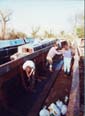
Meanwhile, the inside of the boat was re-sheared. Shearing is thin strips of wood nailed top to bottom of the sides. The side is first coated with a layer of tar/pitch/horse dung mixture which forms a flexible putty and this is coated with sheathing felt and then the shearing. The shearing is nailed down to stop the caulking coming through.
The boat was then filled with water to swell up the seams. When she held water without leaking (too much!) the stern tube was fitted ready for motorising. Swim plates were added to the sides to stop the propellor cavitating. The top flashes were painted and the name repainted. The hull was finally launched in March 2002.
Click on the thumbnails below to view a larger image